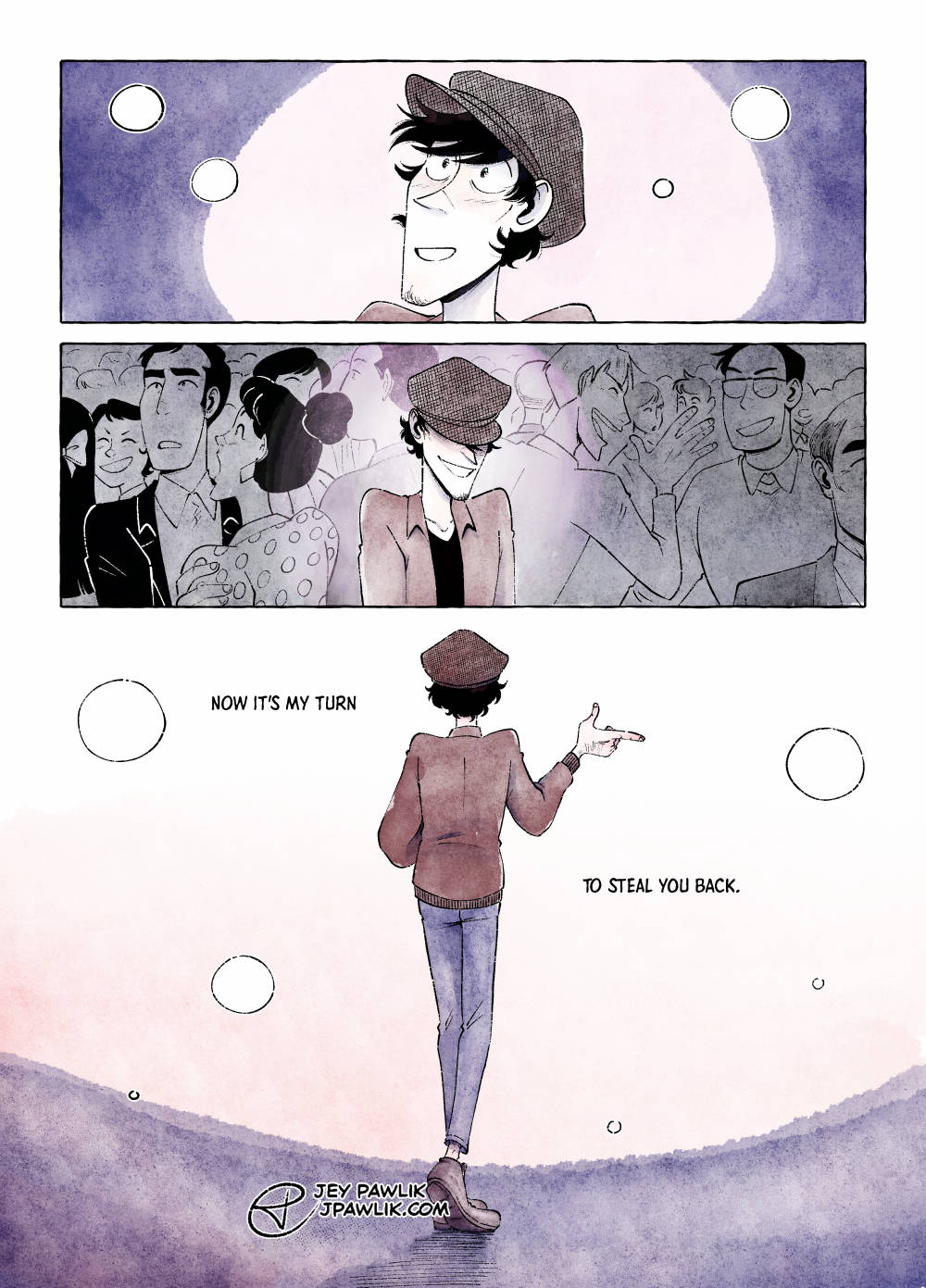
A Lupin the Third fan comic. Jigen is looking up at Lupin in awe - he’s everything he remembered him being and more. He begins walking away from the crowd, but he is no longer nervous and anxious. Lupin the Third is real, and this time Jigen’s going to find him.

Jigen Now and Then – 6

Jigen Now and Then – 6 published on No Comments on Jigen Now and Then – 6

Page 6/6 And then Jigen had hope, he’d found what he was looking for. Thanks for joining us for this Jigen one-shot! We still have some of these books leftover if you missed the pre-order or if you’re from the US shoot us an email and maybe I can work something out without tariffs —… Continue reading Jigen Now and Then – 6
Cover of "The Ins and Outs of Webcomics" by "Jey Pawlik". Black and white illustration with halftones of Jey, a nonbinary person with short cropped black hair and big rectangular glasses running through a panel in a comic page. The background is made up of many blank comic pages with panel layouts on them.

Ins and Outs of Webcomics REMASTER Cover

Ins and Outs of Webcomics REMASTER Cover published on No Comments on Ins and Outs of Webcomics REMASTER Cover

Page 1 of 11, be sure to click ahead for the next page – which is already up! I was inspired while teaching my students to come back to this comic from 2020 and remake it with new up-to-date info & art. I redrew and re-lettered the entire comic and I’m quite pleased with it.… Continue reading Ins and Outs of Webcomics REMASTER Cover

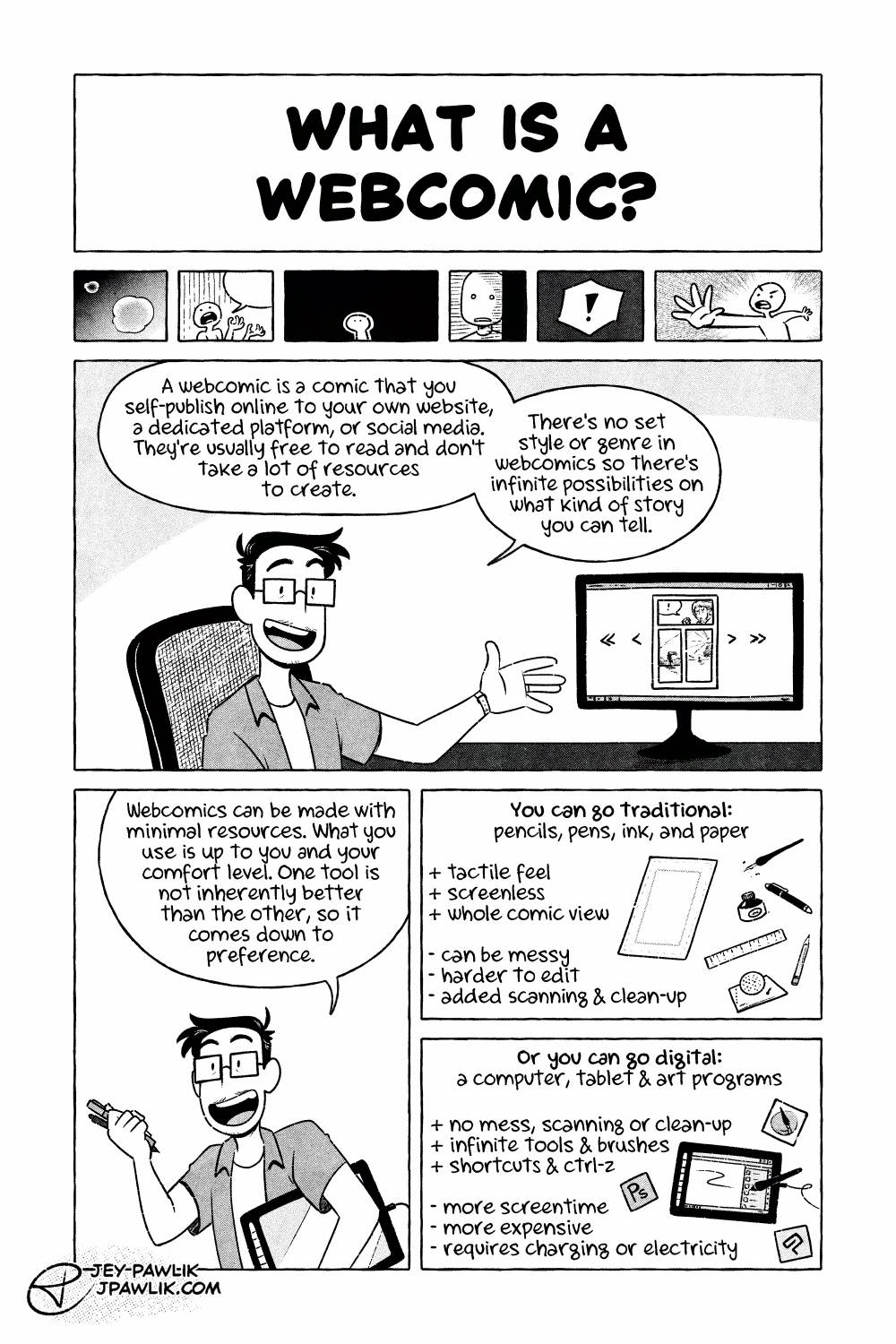
The Ins and Outs of Webcomics, comic page. "What is a webcomic?" 6 small panels show various ways people draw comic panels; steamy bubbles, speech bubbles, beat panels, hatching, sound effects, and motion. Jey is sat at a computer and gestures to a comic page on the monitor while saying "A webcomic is a comic that you self-publish online to your own website, a dedicated platform, or social media. They're usually free to read and don't take a lot of resources to create. There's no set style or genre in webcomics so there's infinite possibilities on what kind of story you can tell." Jey says "Webcomics can be made with minimal resources. What you use is up to you and your comfort level. One tool is not inherently better than the other, so it comes down to preference." While holding pens and a drawing display under their arm. "You can go traditional: pencils, pens, ink, and paper" the panel shows these items next to a pros and cons list. "Pros: tactile feel, screenless, whole comic vie." "Cons: can be messy, harder to edit, added scanning and clean-up" "Or you can do digital: a computer, tablet, & art programs" showing these next to the pros and cons list. "Pros: no mess, scanning, or clean-up, infinite tools & brushes, shortcuts & ctrl-z" "Cons: more screentime, more expensive, requires charging or electricity"

Ins and Outs of Webcomics REMASTER – 1

Ins and Outs of Webcomics REMASTER – 1 published on No Comments on Ins and Outs of Webcomics REMASTER – 1

Page 2 of 11, don’t forget to check out the previous page. Page 1, what is a webcomic? A quick overview. Honestly a webcomic can be anything you want it to be with whatever tools and experience you have available to you. The best thing about webcomics IS that they can be anything. Want to… Continue reading Ins and Outs of Webcomics REMASTER – 1

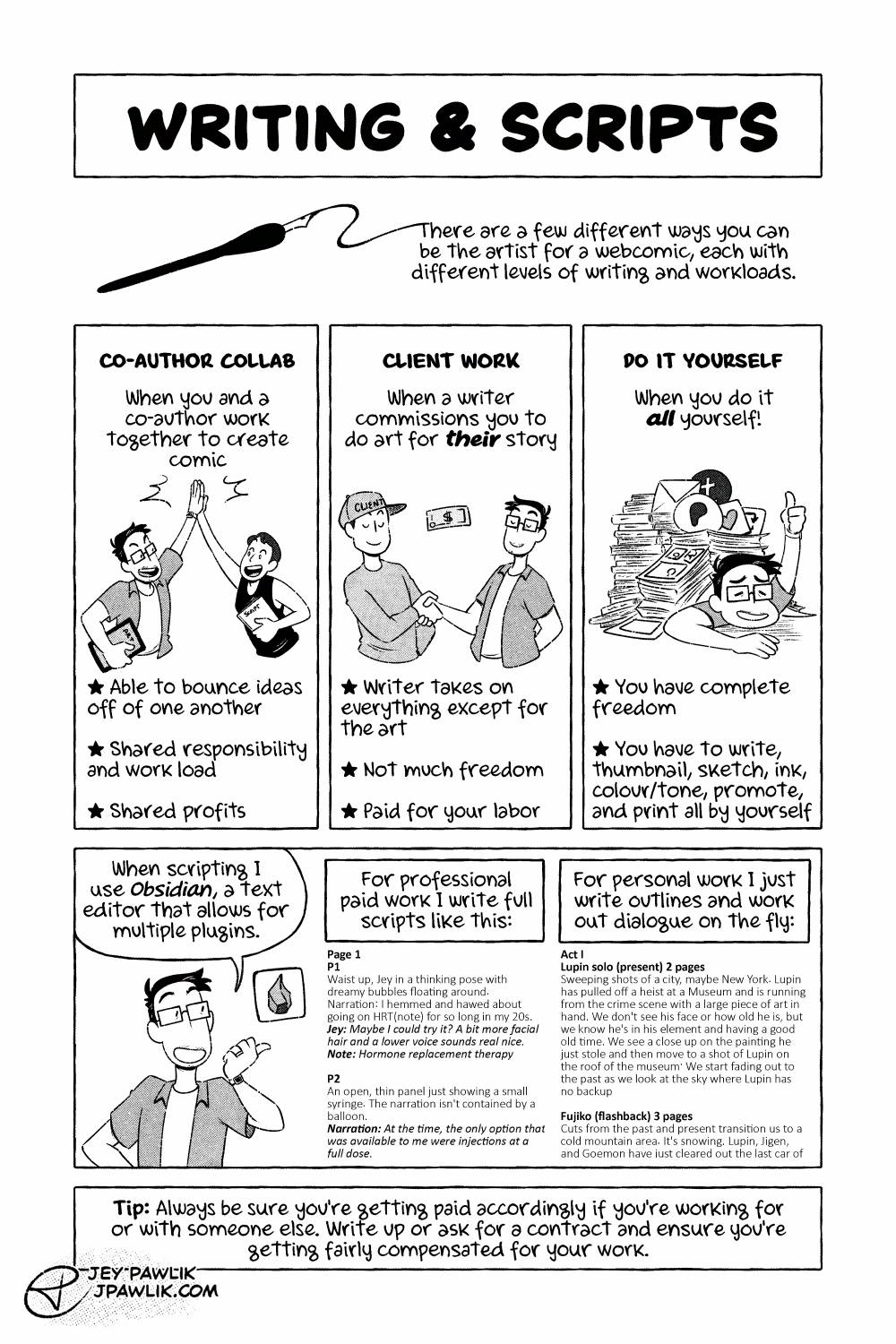
The Ins and Outs of Webcomics, comic page. "Writing & Scripts" a dip pen writes out the text "There are a few different ways you can be the artist for a webcomic, each with different levels of writing and workloads." Three consecutive panels in a row showing the different ways to be the artist. "Co-Author Collab, when you and a co-author work together to create comics" where Jey and Max are in a high five and carrying different workloads. Bullet points read "Able to bounce ideas off one another" "Shared responsibility and work load" "Shared profits" "Client Work, when a writer commissions you to do art for their story." Jey is shaking hands with a writer and money is being passed over. Bullet points read "Writer takes on everyone except for the art" "Not much freedom" "Paid for your labor" "Do it yourself, when you do it all yourself." We see Jey buried in the work load of it all but giving a weary thumbs up. Bullet points read "You have complete freedom" "You have to write, thumbnail., sketch, ink, colour/tone, promote and print all by yourself" Jey gestures to two samples of their scripts and says "When scripting I use Obsidian, a text editor that allows for multiple plugins." A thorough script is shown with the text "For professional paid work I write full scripts." An outline is shown with the text "For personal work I just write outlines and work out dialogue on the fly." A text written tip is at the bottom of the page that reads "Tip: Always be sure you're getting paid accordingly if you're working for or with someone else. Write up or ask for a contract and ensure you're getting fairly compensated for your work."

Ins and Outs of Webcomics REMASTER – 2

Ins and Outs of Webcomics REMASTER – 2 published on 3 Comments on Ins and Outs of Webcomics REMASTER – 2

Page 2 and what scripting and writing a webcomic can look like. I’ve done all three methods here and all have their pros and cons. I switched this page around quite a bit and added what scripting looks like for me when I do it. I’m quite pleased with this new version of the page!… Continue reading Ins and Outs of Webcomics REMASTER – 2

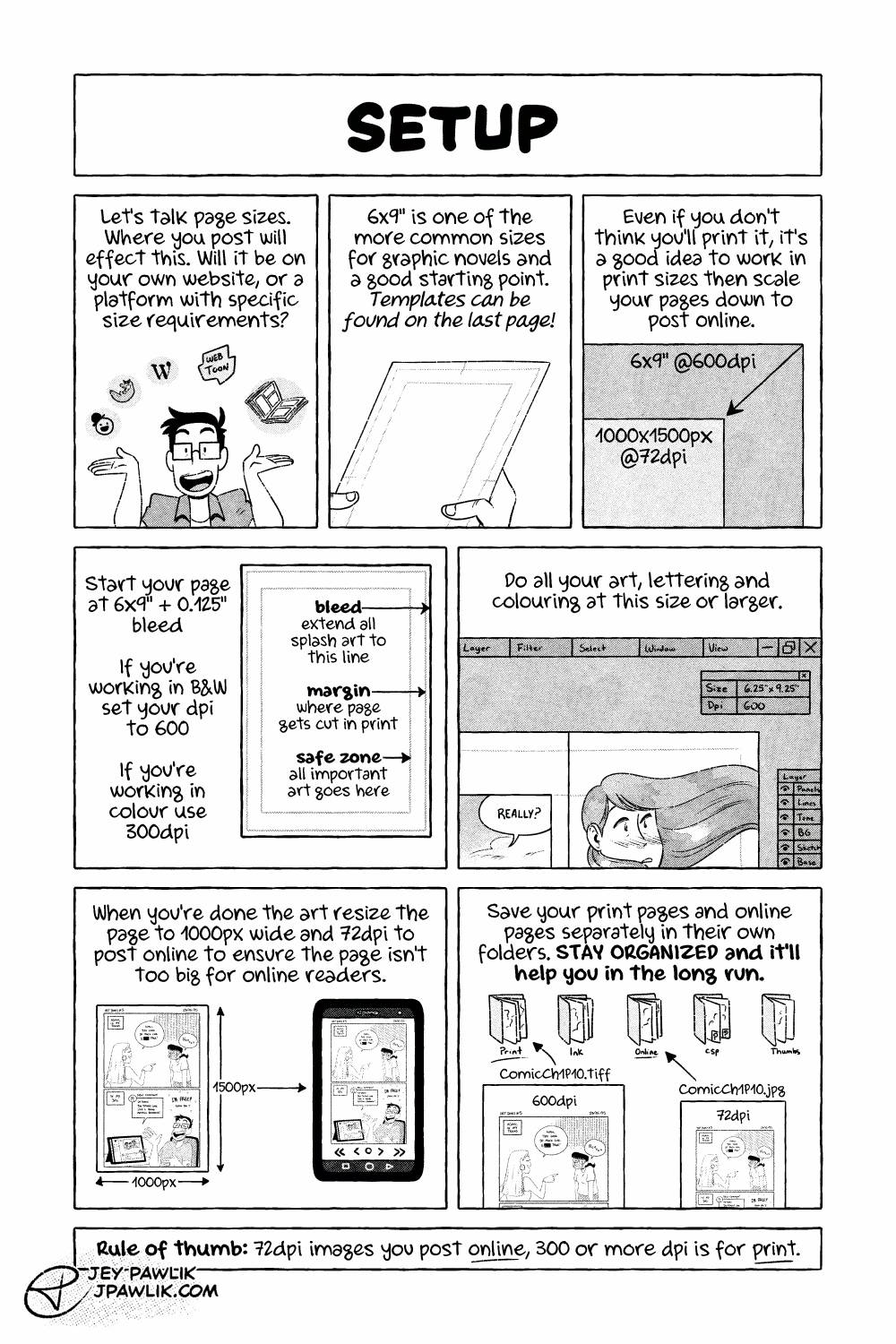
The Ins and Outs of Webcomics, comic page. "Setup" Jey gestures to multiple comic hosting platform logos: tapas, comicfury, wordpress, webtoon, and also physical books. "Let's talk page sizes. Where you post will effect this. Will it be on your own website, or a platform with specific requirements?" Jey holds a piece of paper with a template on it, showing margins and bleed. "6x9 inches is one of the more common sizes for graphic novels and a good starting point. Templates can be found on the last page (or in the description of this page)" An image showing the size different between a 6x9" @600dpi page and a 1000x1500px @72dpi image. "Even if you don't think you'll print it, it's a good idea to work in print sizes then scale your page down to post online." "Start your page at 6x9in plus 0.125in bleed." "If you're working in B&W set your dpi and 600." "If you're working in colour use 300dpi." A sample of the 6x9" template. "Bleed, extend all splash art to this line" this points to the bleed on the template. "Margin, where page gets cut in print" pointing to the margin lines. "Safe zone, all important art goes here." "Do all your art, lettering, and colouring at this size or larger." an illustration of a digital art program, showing the size of the page as 6.25x9.25" and a dpi of 600. The art is being worked on at this size. "When you're done the art resize the page to 1000px wide and 72dpi to post online to ensure the page isn't too big for online readers." Showing the 1000px wide comic page fitting well on a phone screen. "Save your print pages and online pages separately in their own folders. Stay organized and it'll help you in the long run." An illustration of different folders on a computer: Print, Ink, Online, CSP, and thumbs. The 600dpi image being put in the "Print" folder and the 72dpi image sent to the "Online" folder. "Rule of thumb: 72dpi images you post online, 300 or more dpi is for print."

Ins and Outs of Webcomics REMASTER – 3

Ins and Outs of Webcomics REMASTER – 3 published on No Comments on Ins and Outs of Webcomics REMASTER – 3

Page 3 and we’re talking a bit about set-up. You can find my 6×9″ templates that I mention right here! Want to buy a digital or physical copy? Check out the Topaz Comics Shop! Or you can also grab the PDF on Patreon, or itch.io Want to see sketches, thumbnails, and comic pages early? Join… Continue reading Ins and Outs of Webcomics REMASTER – 3

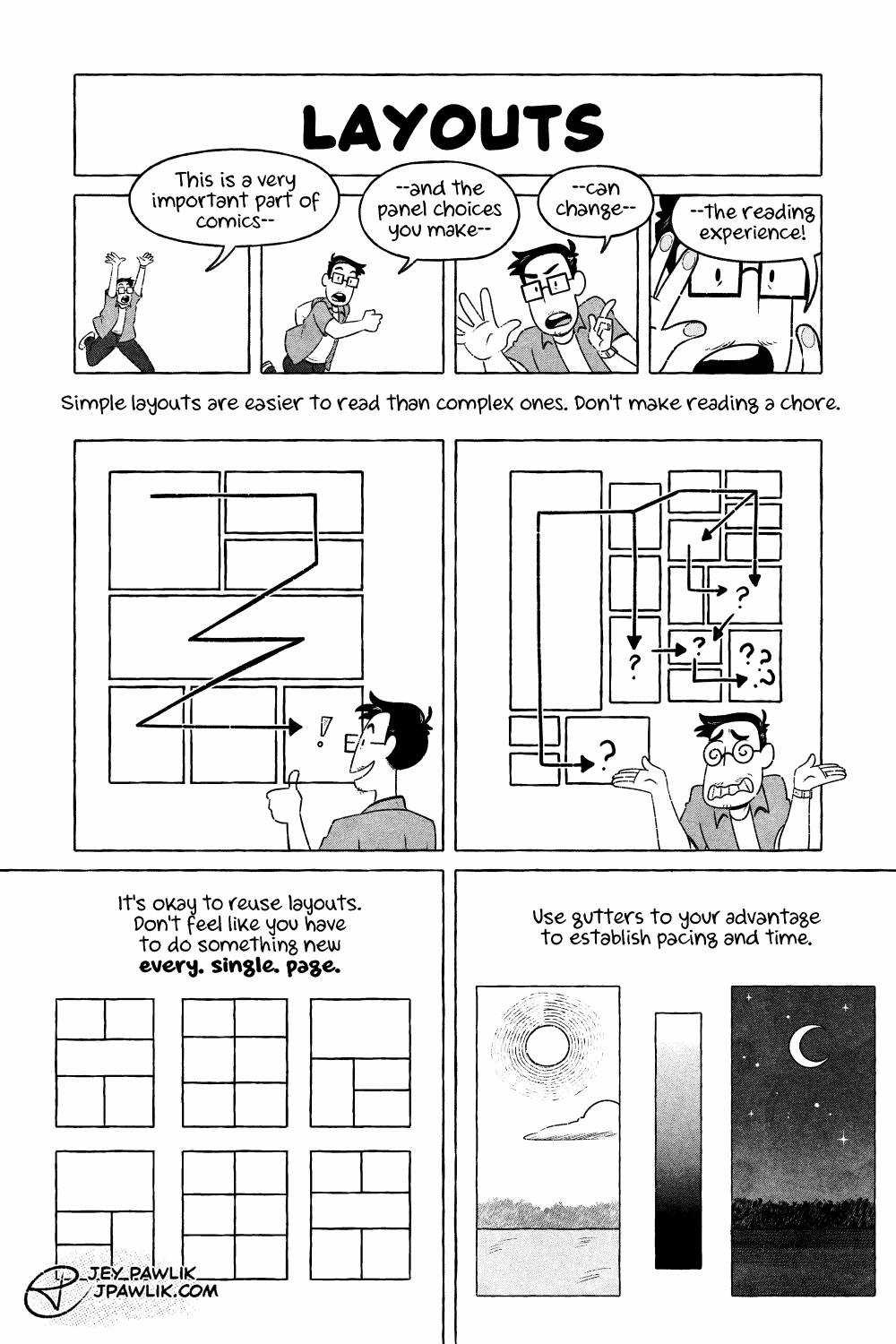
The Ins and Outs of Webcomics, comic page. "Layouts" Four panels where Jey starts off far away and gradually gets closer until their hands are pressed up against the panel. As they get closer they say "This is a very important part of comics-- and the panel choices you make-- can change-- the reading experience!" "Simple layouts are easier to read than complex ones. Don't make reading a chore." Jey is giving a thumbs up beside a simple, easy to read comic page where the eye zig zags through the panels with ease. Jey is dizzy and shrugging confused beside a complex comic page where the eye isn't sure which panel comes next. "It's okay to reuse layouts. Don't feel like you have to do something new every. single. page." Three comic layout examples are shown, and then the same three layouts are shown below just in a different order. "Use gutters to your advantage to establish pacing and time." A panel of a sunny day, with a big gutter between it and a smaller panel with a light to dark gradient, another big gutter, and a panel with the moon and stars in the night sky.

Ins and Outs of Webcomics REMASTER – 4

Ins and Outs of Webcomics REMASTER – 4 published on No Comments on Ins and Outs of Webcomics REMASTER – 4

Page 4, let’s talk layouts! I always struggle with big artsy layouts. Where is my eye supposed to go? Sometimes simple is better. Want to buy a digital or physical copy? Check out the Topaz Comics Shop! Or you can also grab the PDF on Patreon or itch.io Want to see sketches, thumbnails, and comic… Continue reading Ins and Outs of Webcomics REMASTER – 4

Ins and Outs of Webcomics REMASTER – 5

Ins and Outs of Webcomics REMASTER – 5 published on No Comments on Ins and Outs of Webcomics REMASTER – 5

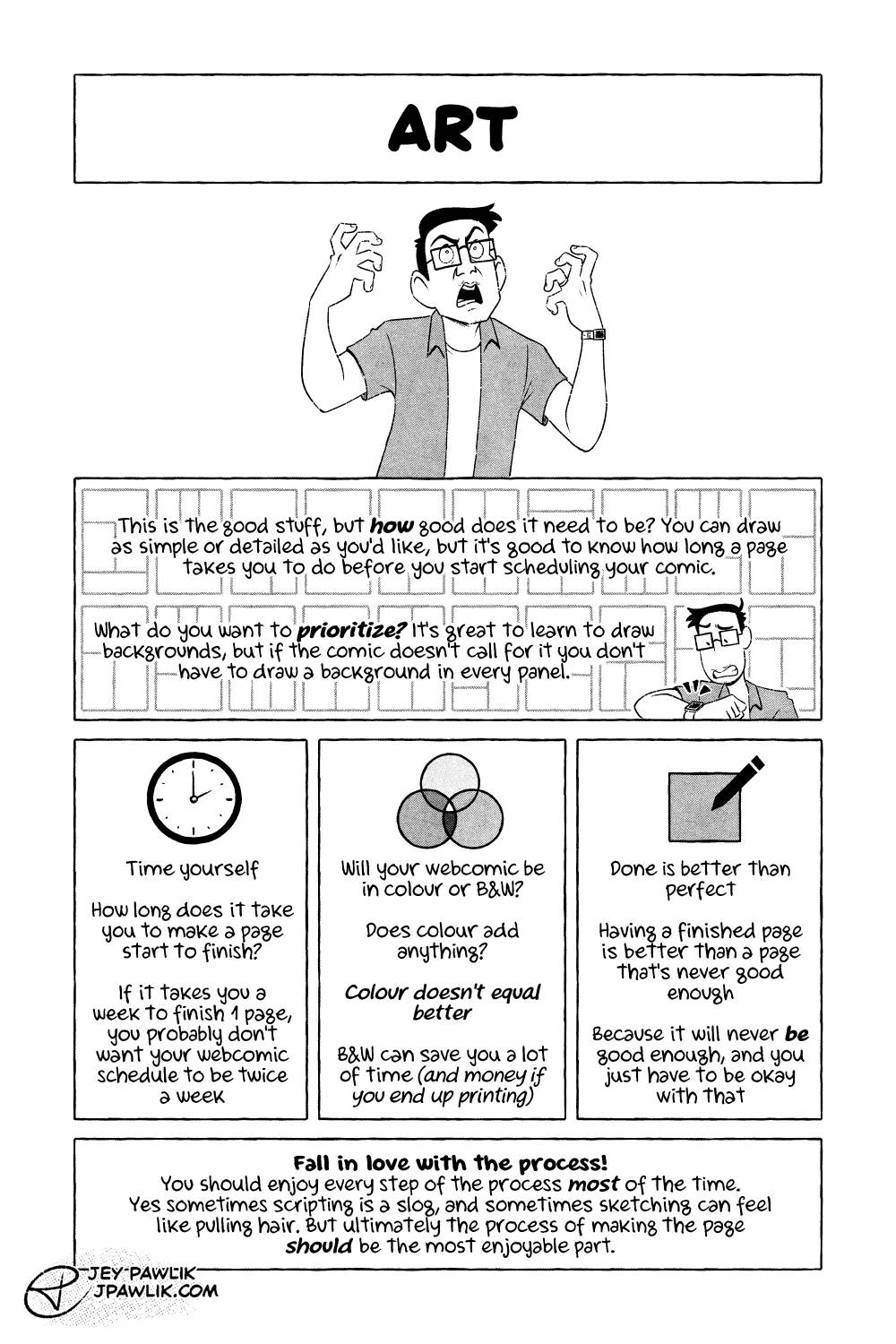
Page 5 and let’s get to the good stuff. The stuff you WANT to do! Want to buy a digital or physical copy? Check out the Topaz Comics Shop! Or you can also grab the PDF on Patreon or itch.io Want to see sketches, thumbnails, and comic pages early? Join us on Patreon!