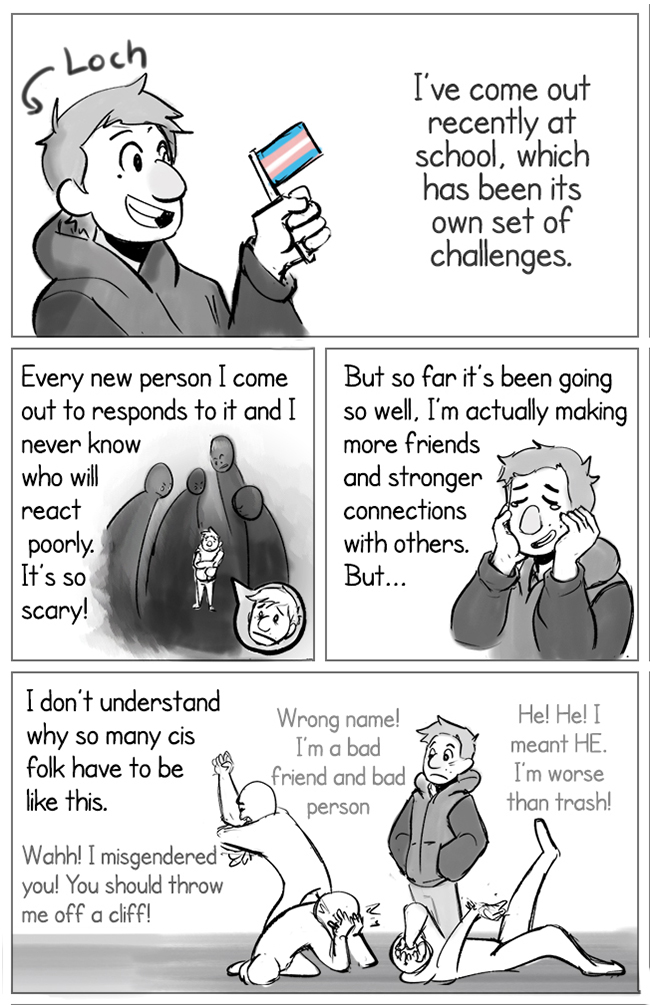
I’ve had a few family friends react like this. Here’s what I told them, more-or-less:
“Look, I get that you want to support me, and that’s great! The best way to do that is—just don’t make a big deal out of it! Apologizing like that calls attention to the mistake, and that’s the opposite of what I want.”
Or, more harshly:
“Please don’t fall over yourself to apologize. I get that you feel bad, but that isn’t what matters here: being a good ally means centering the needs of trans people, not your own feelings, and I need you NOT to make this into a bigger deal than it has to be.”
I’ve been out for five years; at this point I rarely have to “re-introduce” myself. Many of my friends have only ever known me by my chosen name, which is a wild and wonderful thing to think about! As far as social stuff is concerned, I’ve made the transition—and it’s called transition for a reason, y’know? It’s the awkward bumpy phase where you and the people who love you readjust. Once that’s over and you’ve settled in, you get to just be yourself for the rest of your life, and it’s the best thing in the world.
What I did is tell them “the best way to respond to a mistake is to fix your sentence with the right pronoun. That’s all I want. No apologies, just restate what you said with the right pronoun and it will completely undo any harm as far as I’m concerned. If I had to correct you and you *really* want to go above and beyond, thank me for correcting you and *then* fix your statement.”
Well, I can’t speak for other people, but ib my case I’m an anxious person, and even though I have not yet crossed paths with a non-binary person, I’m aware it should be mandatory to at least consider people may have a different gender from the one you perceive, and ask their preferences instead. If, out of habit, I misgender someone that explicitely told me their pronouns before hand, I’m pretty sure I would have a very visual, very ashamed reaction. But that’s just how my head works.

3 Comments
I’ve had a few family friends react like this. Here’s what I told them, more-or-less:
“Look, I get that you want to support me, and that’s great! The best way to do that is—just don’t make a big deal out of it! Apologizing like that calls attention to the mistake, and that’s the opposite of what I want.”
Or, more harshly:
“Please don’t fall over yourself to apologize. I get that you feel bad, but that isn’t what matters here: being a good ally means centering the needs of trans people, not your own feelings, and I need you NOT to make this into a bigger deal than it has to be.”
I’ve been out for five years; at this point I rarely have to “re-introduce” myself. Many of my friends have only ever known me by my chosen name, which is a wild and wonderful thing to think about! As far as social stuff is concerned, I’ve made the transition—and it’s called transition for a reason, y’know? It’s the awkward bumpy phase where you and the people who love you readjust. Once that’s over and you’ve settled in, you get to just be yourself for the rest of your life, and it’s the best thing in the world.
What I did is tell them “the best way to respond to a mistake is to fix your sentence with the right pronoun. That’s all I want. No apologies, just restate what you said with the right pronoun and it will completely undo any harm as far as I’m concerned. If I had to correct you and you *really* want to go above and beyond, thank me for correcting you and *then* fix your statement.”
Well, I can’t speak for other people, but ib my case I’m an anxious person, and even though I have not yet crossed paths with a non-binary person, I’m aware it should be mandatory to at least consider people may have a different gender from the one you perceive, and ask their preferences instead. If, out of habit, I misgender someone that explicitely told me their pronouns before hand, I’m pretty sure I would have a very visual, very ashamed reaction. But that’s just how my head works.